
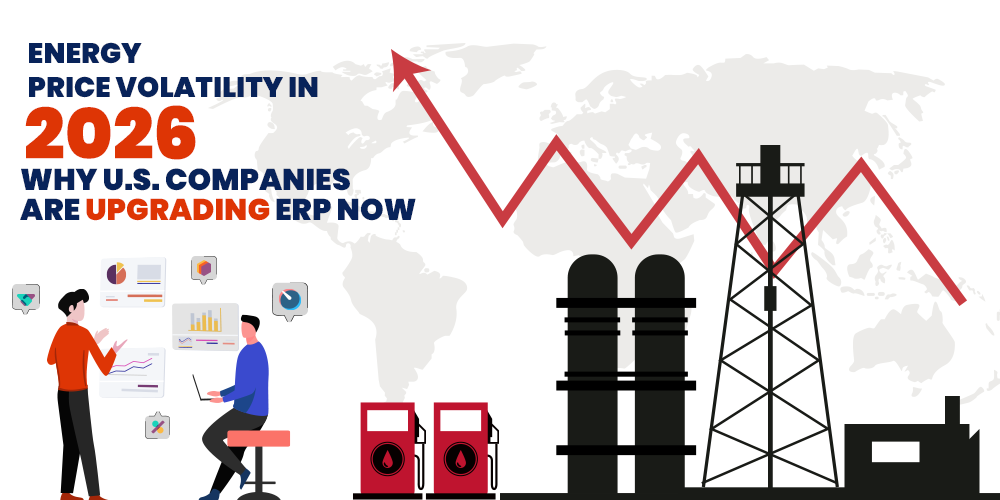
In 2026, U.S. businesses are operating in an environment shaped by energy price volatility as the Middle east war continues at the moment. Today’s businesses are facing tighter margins, and continued pressure to improve productivity. While inflation has eased compared to previous years, the cost of natural gas, electricity, and logistics remains unpredictable—particularly for manufacturers and distribution-driven businesses.
This shift is forcing companies to look inward. What once appeared as manageable inefficiencies are now becoming significant cost drivers as the cost of energy is rising at record rates. One needs to keep in mind that when energy prices rise, every extra machine hour, every excess unit of inventory, and every delay in decision-making directly impacts profitability.
Many organizations are still operating on fragmented systems—spreadsheets, disconnected software, and manual processes that limit visibility. In stable times, these gaps may go unnoticed. But in today’s environment, they create blind spots that businesses can no longer afford. So where do we go from here? How do these companies better improve their fate and more so efficiencies?
This is where modern ERP systems are quietly becoming essential.
Platforms like Odoo are not just about digitization; they are about clarity and precision. By connecting inventory, accounting, procurement, and operations into a single system, businesses gain real-time insight into how their operations are performing—and where costs are accumulating. Instead of reacting weeks later, leadership teams can make decisions in the moment.
A mid-sized manufacturing company in the U.S. Midwest recently faced this exact challenge. As natural gas prices increased, their operational costs began to climb this was the moment that the company really needed to scale back but didn’t have the tools to understand how to approach the matter. They later on realized it was due to lack of systems such as; production schedules were still managed manually, inventory levels were inconsistent, and machines were often running longer than necessary simply due to poor coordination between teams.
What had previously been small inefficiencies quickly compounded into meaningful financial pressure due to the price surge.
The company chose to implement Odoo through a phased approach, beginning with inventory, manufacturing, and accounting. The shift did not disrupt operations—instead, it revealed them.
With real-time visibility, production planning became more precise. Machines were scheduled more efficiently, reducing unnecessary run-time and energy consumption. Inventory levels became aligned with actual demand, freeing up working capital that had previously been tied up in excess stock. Financial reporting, once delayed, became immediate and actionable.
Within months, the business was no longer reacting to rising costs—it was actively managing them.
This kind of transformation is becoming increasingly common especially in these hard times.
Another important shift is how ERP systems are being adopted. In the past, implementation was often seen as a large, risky investment. Today, platforms like Odoo allow companies to start small and expand over time. This modular approach gives businesses the flexibility to modernize without placing unnecessary strain on capital—an important advantage in a higher interest rate environment.
Looking ahead, energy markets and operating costs are unlikely to stabilize completely until the war is over and the world has less uncertainty. Companies that continue to rely on outdated systems will find themselves increasingly reactive, while those that invest in operational visibility and efficiency will be better positioned to adapt.
Upgrading an ERP system is no longer just a technology decision—it is a strategic one. In a world where costs can shift quickly, the ability to see, understand, and respond in real time is what separates resilient businesses from those constantly playing catch-up.
Book a demo with ComstarUSA today.
FAQ’s
- Why are companies upgrading ERP systems in 2026?
Many businesses are upgrading ERP systems to better manage operational costs, automate processes, and improve energy efficiency as global energy prices continue to rise.
- How can ERP help reduce energy costs?
Modern ERP platforms track energy usage, optimize supply chains, automate workflows, and reduce operational waste, helping businesses control rising expenses.
- Which ERP solutions help manage energy and operational costs?
Popular ERP solutions such as Odoo, SAP ERP, and Oracle NetSuite help companies analyze operational data and improve cost efficiency.
- Is upgrading ERP necessary for small and medium businesses?
Yes. Small and medium businesses can benefit from ERP systems because they provide better resource planning, financial visibility, and automation to manage rising operational costs.
- How does ERP improve business efficiency during economic uncertainty?
ERP systems centralize data, automate processes, and provide real-time insights that help companies make smarter decisions and stay competitive during periods of rising costs and economic pressure.