
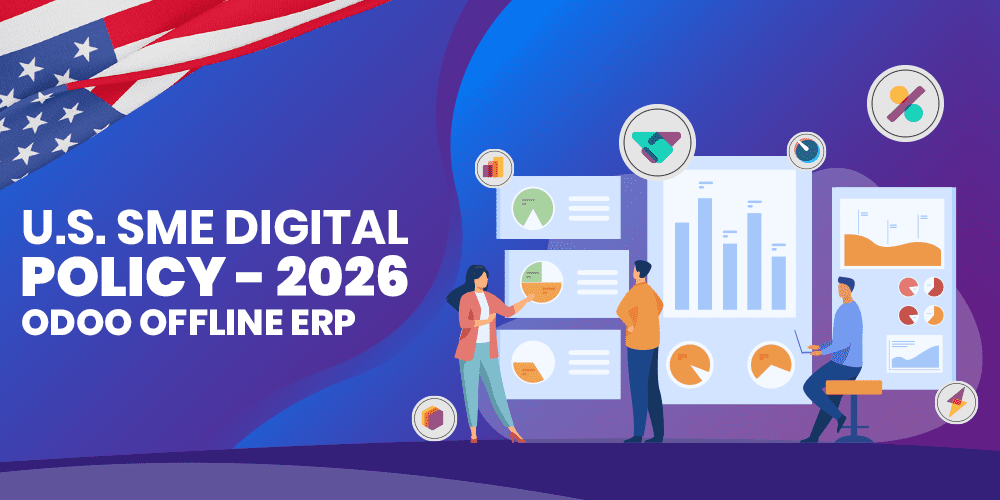
ComstarUSA is already working with American SMEs preparing for the shift in digital compliance, government reporting, and operational transparency expected in 2026. While policy reforms are intended to modernize the economy, they create significant pressure on smaller businesses that lack IT depth and infrastructure. As new compliance mandates increase the need for traceable, auditable, and digitized business processes, the technology foundation chosen by SMEs becomes a strategic variable rather than a back-office detail.
The most urgent shift centers around digital reporting. Regulators and government agencies are pushing for real-time invoice traceability, automated tax compliance, digitally verified procurement trails, integrated inventory valuation, and accurate general ledger reconciliations. These requirements burden SMEs that still rely on spreadsheets or siloed tools. Compliance becomes labour-intensive, error-prone, and costly. In contrast, an integrated ERP such as Odoo automates source-level reporting, creating a seamless digital compliance backbone that feeds tax submissions, financial statements, and audit trails.
However, there is an overlooked constraint: connectivity. Much of America’s SME economy operates in environments with unstable or inconsistent internet. Manufacturing workshops, fabrication facilities, natural stone yards, distribution warehouses, service centres, retail POS desks, and water purification operations frequently experience network connectivity issues. Pure cloud-native ERPs freeze under those conditions, leaving businesses unable to generate invoices, record transfers, issue work orders, log production, or capture retail transactions until the connection returns. SME compliance cannot depend on Wi-Fi uptime.
This is where Odoo offers a structural advantage. Its offline module layer enables critical operational tasks—such as POS transactions, warehouse barcode scanning, field sales orders, manufacturing work orders, and stock transfers—to continue in offline mode. Once connectivity is restored, the system synchronizes automatically and preserves timestamp integrity. That continuity not only protects revenue but maintains compliance-grade audit trails without manual reconstruction.
In 2026, SMEs will also face new expectations around tax automation and integrated digital filing. Odoo’s accounting module already connects directly to procurement, inventory valuation, manufacturing costs, invoicing, and general ledger movements. This allows tax reporting and financial compliance to emerge naturally from operational transactions rather than being assembled manually at month-end. SMEs that adopt platforms like Odoo early will not need to expand administrative headcount when compliance intensifies.
The broader strategic implication is that 2026 rewards SMEs that invest in digital continuity rather than merely digital interfaces. Offline ERP capability becomes a differentiator because it protects both compliance and operational uptime. For American SMEs, Odoo offers an accessible, integrated, compliance-ready system that simplifies regulatory compliance without disrupting day-to-day operations.
ComstarUSA is helping SMEs deploy Odoo in a manner that meets both regulatory expectations and operational realities, particularly in industries where connectivity cannot be guaranteed.
Book an appointment with ComstarUSA to evaluate how Odoo’s offline and compliance-ready architecture can prepare your SME for 2026.
FAQ’s
Q: What are the key US policy shifts affecting SMEs in 2026?
A: In 2026, US policy shifts impacting SMEs include stricter compliance reporting, data retention requirements, tax transparency rules, and increased regulatory audits. These changes require businesses to maintain accurate, accessible, and resilient operational data.
Q: Why is SME compliance more challenging in 2026?
A: SME compliance is more challenging in 2026 due to evolving regulations, digital reporting mandates, system downtime risks, and limited IT resources. SMEs must ensure uninterrupted access to compliance data even during connectivity or system disruptions.
Q: What is an offline-ready Odoo ERP?”
A: An offline-ready Odoo ERP allows businesses to continue critical operations such as invoicing, inventory tracking, and data entry even without an active internet connection, syncing data automatically once connectivity is restored.
Q: How does offline-ready Odoo ERP help with compliance?
A: Offline-ready Odoo ERP helps with compliance by ensuring continuous record-keeping, preventing data loss, supporting audit readiness, and maintaining operational continuity during outages or restricted network access.
Q: Is offline ERP necessary for all SMEs?
A: While not mandatory for all SMEs, offline ERP is essential for businesses operating in regulated industries, remote locations, or environments where internet reliability, cybersecurity risks, or regulatory continuity are critical concerns.