
The U.S. retail market is still seeing sales, but the conditions around those sales have become harder to understand. In August 2026, retail and food service sales totaled $773.9 billion, a 6.0% increase compared to August 2025. Yet consumer sentiment dropped to 48.1 in September, reflecting worries about prices and personal finances. For retailers, this means a balancing act. People are still buying, but strong sales do not always mean better profits or steady cash flow. Odoo POS can help retailers connect sales activity with inventory, purchasing, customer data, and accounting, giving them a clearer view of where money is being made and where efficiencies can be created.
Retailers Are Operating in an Uncertain Environment
The U.S. economy is sending mixed signals to retailers. Consumers are still spending, but inflation is eating away at their ability to afford things. In August 2026, the Consumer Price Index was 3.4% higher than a year earlier, while gasoline prices jumped 3.9% in the same month. Businesses also face rising costs in transportation, labor, energy, and sourcing products.
For retailers, profits are not only about how much they sell. Higher costs for inventory, shipping, or operations can cut into margins even when sales go up. This is why choosing the right pos systems for retail can also matter, as better sales data can help retailers understand what is selling and where costs are affecting the business.
The larger economic and policy environment adds more uncertainty. Changes in tariffs, trade rules, taxes, government spending, interest rates, and energy prices can all affect business costs and how much people spend. Retailers cannot control all of these changes, but they can understand their own numbers well enough to respond when things shift.
Consumers Are Still Spending. They Are Watching Their Money
Americans haven’t stopped buying. Retail and food service sales in the U.S. Rose 1.2% from July to August 2026. Were 6.0% higher than in August 2025. Still consumer sentiment fell to a four-month low in September with growing concerns about inflation and personal finances. This mix creates a challenge for retailers. People may keep buying. They are more careful about where their money goes. They might compare prices, wait for discounts, switch brands or focus on items. Retailers need to look beyond how many sales they make. They need to know which products bring in revenue and profit, which promotions work best and where customer behavior is shifting. Having access to sales and customer data helps businesses react based on actual activity instead of guesses.
Rising Costs Can Change the Value of Every Sale
Revenue doesn’t tell the full story of a retail business. If the cost of getting a product to the customer. From buying it, shipping it, storing it to selling it. Going up a sale that used to be profitable may now give a return. Transportation is one example. Higher fuel prices and logistics fees can raise the cost of moving goods for retailers that rely on imports or complex supply chains. That makes it important to see costs clearly. Retailers need to know what they are selling, how much they paid, how much stock is left and how all this affects cash flow. An Odoo POS system can link sales data with inventory, purchasing and accounting. By seeing a sale as just a checkout moment retailers can connect it to the full picture of what that sale means for the business.
Inventory Decisions Can Tie Up Cash Than Expected
Inventory is especially important when retailers are trying to protect their cash flow. Buying much stock ties up money in products that don’t move. Buying little can lead to out-of-stock items and lost sales. This is why many businesses need more than a basic point-of-sale system. A checkout system records what sold. Retailers also need to understand what that means for inventory and buying decisions.
If one product line is selling faster than expected while another sits on the shelves that difference should shape the purchase. Without data employees may have to compare different reports or spreadsheets. With Odoo POS sales data can link to inventory and purchasing giving a view of stock movement and where capital is stuck.
The Problem With Running Retail on Disconnected Systems
Many retailers use systems for checkout, e-commerce, purchasing, customer data and accounting. Each system may work on its own. The gaps between them can create extra work.Employees might have to enter data than once compare separate reports or manually fix numbers. When costs are already high that extra work adds up.
This is where connect POS system to the rest of the business becomes important. Retailers need to move from a transaction to the full information behind it: inventory, customer behavior, buying, revenue and accounting.The goal isn’t to add more software. It’s to close the gap between the data a retailer already gathers and the decisions that must be made from it.
E-Commerce Makes Connected Data More Important
Retail isn’t just about physical stores anymore. U.S. E-commerce sales reached $340.2 billion in the quarter of 2026 making up 17.1% of total retail sales. E-commerce sales were also 12.2% higher than in the period in 2025. For retailers who operate both in-store and online disconnected data can give a view of the business. A product might sell in a store and online on the day so accurate inventory information matters across both channels. Customer data faces the issue. Someone who shops in a store and later buys online shouldn’t appear as two customers. Connecting both activities helps retailers understand demand instead of looking at each channel separately.
Purchasing Needs to Follow What the Business Is Actually Selling
Economic uncertainty changes how retailers decide what to buy. When money is tied up in inventory every purchase order should be carefully considered. Retailers must look at sales, current stock levels, supplier prices, customer demand and how quickly products sell. A purchase decision based on past sales may not make sense if customer habits or costs have changed.A connected Odoo POS system can bring sales data with inventory and purchasing information. This gives retailers a picture to make purchasing decisions from. Technology doesn’t make the decisions itself. Seasonality, supplier relationships, product plans and management experience still matter.. Having the right information in one place makes those decisions better and faster.
CRM Can Help Retailers Understand Where Revenue Comes From
When customers are more careful about spending, understanding existing customers becomes more valuable. Retailers can look at buying habits, customer activity and interactions to see which products and customer groups are driving sales. Connect POS data with a CRM system adds another layer of insight. A sale can become part of a picture of the customer relationship not just disappear into a report after the transaction. Retailers may then spot repeat buying patterns or products that customers often buy together. This can support promotions and communication without guessing.The goal is not to push customers to spend more. It is to understand demand and make smarter choices about how to serve customers.
Accounting Should Reflect What Is Happening on the Sales Floor
Cash flow becomes easier to understand when financial data matches what happens in the store. If sales, purchases, inventory and accounting are kept in systems, getting an accurate picture takes extra work and manual steps.A connected system can bring these areas closer. When a sale is recorded through Odoo POS it becomes part of the operational and financial data used by the business. This allows management to ask more than just “How much did we sell?” They can also ask: Which products made that money? How much inventory remains? What did those products cost? What purchasing orders are coming up? How is customer demand changing?These questions become more important when profit margins and cash flow are under pressure.
Efficiency Becomes a Retail Strategy, Not an IT Project
The current retail environment does not show one simple trend. Sales are still strong, and e-commerce keeps growing, while inflation and weak consumer confidence are adding pressure. For retailers, operational efficiency is no longer an IT project. It is a business strategy. Choosing the right pos systems for retail can help businesses connect sales data with inventory, purchasing, customers, and finances, giving them better context to respond when market conditions change.
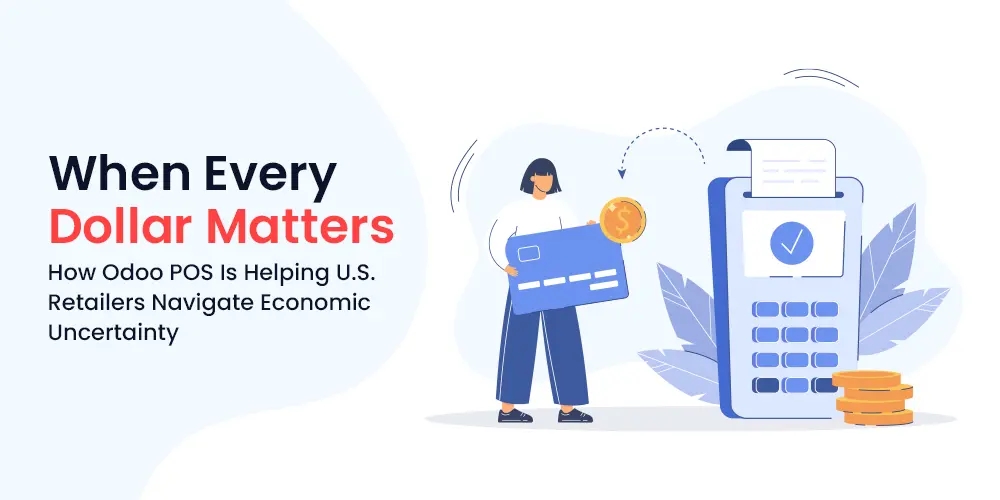
This is the value of Odoo POS. It brings point-of-sale activity into a system that includes e-commerce, inventory, purchasing, CRM and accounting. By treating each part as a separate data source retailers can build a more connected view of the business.When every dollar matters the question isn’t how to sell more. It’s how to understand each sale, manage the inventory behind it, control costs and protect cash flow. For U.S. Retailers navigating an economy that visibility turns everyday business data into a clearer base, for deciding where money is earned, where it is spent and how the business can run more efficiently.