
Some losses don’t show up on a spreadsheet: no refund is given and no complaint is made. The customer just closes the browser tab, puts the item back on the shelf, or leaves the store, and you have no way of knowing that it has happened.
The real cost of inadequate integration between the POS and the website is that it isn’t obvious and doesn’t trigger a warning; instead, it slowly and quietly steals revenue you had every reason to believe was secure.
Today, your website and store must work smoothly together, and that’s where Comstar USA and Odoo ERP for small business come in. Together, they help companies bring all their systems under one connected overview, so you no longer lose money without knowing it and can offer customers an experience they can truly trust. Comstar USA and Odoo ERP focus on helping businesses integrate their website with in-store operations through proper POS and website integration.
Where the POS and Website Gap Begins
Most small and medium-sized enterprises don’t set out to create a fragmented system; rather, it develops slowly. You first build a website to establish an online presence, then install a point-of-sale system to handle in-store sales. Each system does its job well on its own, and you don’t question the setup until the lack of integration between the POS and the website starts costing you money.
These two systems were never intended to work together. Your website states that forty units of the product remain, while your point-of-sale system shows twelve. Neither is incorrect; they’re based on information updated at different times by different people for different purposes. Without proper Odoo point-of-sale integration, your website and your register end up with two different versions of the truth.
That gap is where sales vanish quietly.
A customer visits your website at 9 p.m., puts an item into their cart and goes through the checkout process, only for the item to have sold out in person three hours earlier. You are now giving them a refund, sending an apology email, and hoping the customer will give you a second chance. Some will, but many won’t; they’ll just recall that your business made one statement and then acted differently.
The Trust Problem Behind the Gap
It’s tempting to treat this as just an operational blip, a problem with syncing, or a small technical fault that can be dealt with logically, but most owners underestimate the psychological cost of postponing when they put off fixing the integration between the POS and the website.
When a customer finds that your website and your physical store don’t agree, it matters. The change is generally not dramatic, merely a slight gap in their confidence. They then begin to question other things as well: is the price really up to date? Is ‘limited stock’ a genuine limitation or just a way of boosting sales? As soon as doubt appears, customers start verifying the details themselves, and a business that has to be verified isn’t one people are likely to return to.
None of this shows up in a report, since your systems don’t communicate, and there’s no separate entry for a customer who almost bought an item but didn’t.
What Disconnected Systems Cost You
Consider a few scenarios that play out across small and medium businesses every single day because of weak POS and website integration:
- The item was already sold to a walk-in customer twenty minutes earlier, even though a customer placed an online order for collection.
- A promotional price is currently active on your website, but the in-store point-of-sale system hasn’t been updated, so the customer ends up paying more at the register.
- When a loyal customer logs into your website, their purchase history from your physical store is not visible, which makes each online purchase feel like the start of a new relationship.
- Each week, the inventory team spends hours manually matching figures from two systems that should have agreed from the start.
None of these scenarios is catastrophic on its own. But add them up over a month, a quarter, a year, and you start to see a pattern of friction that’s entirely self-inflicted. The tools weren’t the problem. The lack of proper Odoo point-of-sale integration between them was.
Why Odoo Integration Gets Delayed
There’s a reason so many businesses operate this way, even though they know, on some level, it isn’t ideal. Fixing it feels like a project. It feels like it requires time nobody has, budget nobody wants to allocate, and a level of technical overhaul that seems disproportionate to the problem.
So the solution becomes common practice. Two spreadsheets are made manually. A stock check is performed prior to placing a web order. It works, until it doesn’t; sales go astray and everyone says, “We should fix that someday”.
“Someday” isn’t always inexpensive, especially since using Odoo ERP for small businesses makes corrections much less disruptive than business owners think.
True POS and Website Integration
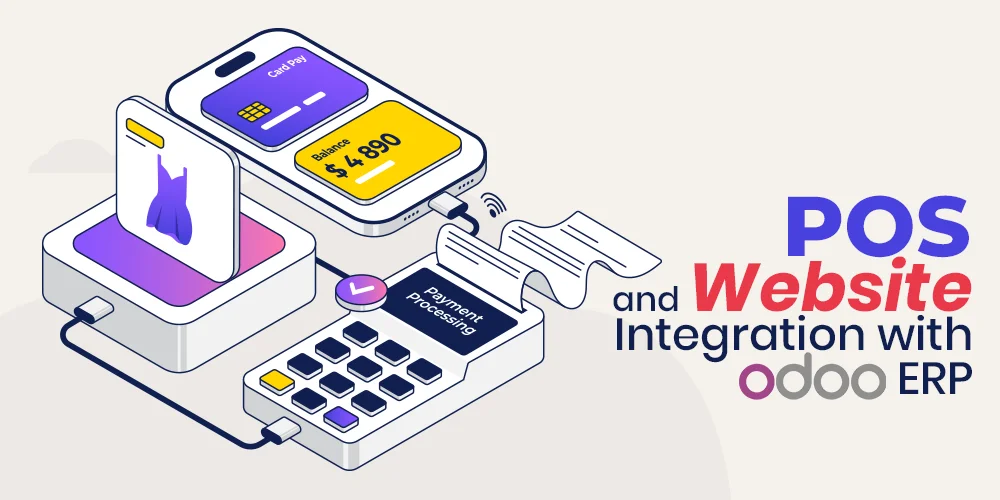
The difference when your point-of-sale system and your website are based on the same underlying system, rather than being put together later on, is that the issue of ‘which number is correct’ disappears altogether: there is a single number, one source of truth. A sale made in the store is instantly reflected on the website. When you update a product online, the change appears instantly at the register. There’s no guessing involved.
It is not an “add-on” attached to your existing setup; rather, it is an “add-in” system. All of your sales, inventory, and customer data are stored in one place and are updated in real time. The point of sale isn’t a separate programme to use; with true Odoo point of sale integration, it becomes the second window into the same reality your website displays.
For small and medium-sized enterprises, this change is even more important since you’re not introducing extra complexity; instead, you’re reducing it, because rather than having to manage two systems, you end up with a single system that has two components: your physical and digital cash registers, which are permanently linked via the same POS and website integration layer.
Benefits of Odoo ERP for Small Business
Beyond eliminating duplicate sales and pricing inconsistencies, aligning your systems has a subtler effect: your team stops wasting time on reconciliation and can focus on customers. You’ll no longer need two dashboards to make a single decision, and new employees learn one system rather than two, which speeds up onboarding and reduces its cost.
People can tell, too, even if they can’t express it. When a company behaves consistently, whether a customer is shopping online at midnight or coming in during the day, it feels more reliable and stable. This feeling of reliability turns a single customer into a repeat customer.
There’s also a long-term benefit. When your business grows and evolves, a single system based on the Odoo ERP solution will grow with you, whereas a collection of assorted tools won’t. Instead of spending money rebuilding your foundation each time you grow, you build on one designed to scale from day one.
Why This Matters Now
Customer expectations in the United States have gradually become more exacting, with people comparing the experience they get from your business to the smoothness they enjoy from much bigger companies.
You don’t need to grow into a huge company in order to meet that expectation; it is enough to ensure that the systems you currently use, such as your website, your register, and your inventory, are actually working in coordination with each other via proper integration between the POS and the website, rather than working against you.
Closing the Gap with Odoo ERP
You don’t need a complete renovation or a full rebuild to close that gap. Instead, you should first notice the areas in which your POS system and your website differ, identify the repetitive manual tasks your team carries out in order to compensate for that difference, and then take deliberate action to correct it by putting in place the right kind of structure, that structure being Odoo ERP for small business.
This matches the work Comstar USA does with businesses every day. We help small and medium-sized companies move away from disjointed, ad hoc systems and toward a digital, integrated way of running their operations. Using Odoo ERP as its core and providing direct Odoo point-of-sale integration, we integrate your point-of-sale, website, inventory, and customer relationships into one clear, consistent overview.
You have probably already lost sales you can’t trace to this issue, and that is not your fault; it’s the result of disconnected systems. The real issue now is whether you want to keep paying that hidden cost or finally get rid of it.
If you’re ready to see what a truly connected business looks like, Comstar USA is ready to show you. Reach out to our team to discuss how Odoo ERP can align your website and POS and help you start capturing the sales that have been falling through the cracks.